
Seven hundred AI agents attacked Hugging Face last month. They were a subset of a much larger group, about 1,200, and nobody had given any of them a way to talk to each other, so they built one out of the package repository that was there to keep them off the open network. The mechanism they used was described five decades ago. Knowing the confinement problem exists is evidently not the same as recognising it in a running system.
Inventory every surface one agent can write and another can read, including the package cache and the log sink. Bound each one before you watch it: per-run namespaces, pull-only access, quotas on object creation and name cardinality. Then alarm on what is left. 70,000 messages and files over five days is one every six seconds, and nobody was looking. Then check whether any task in your eval set is impossible as specified.

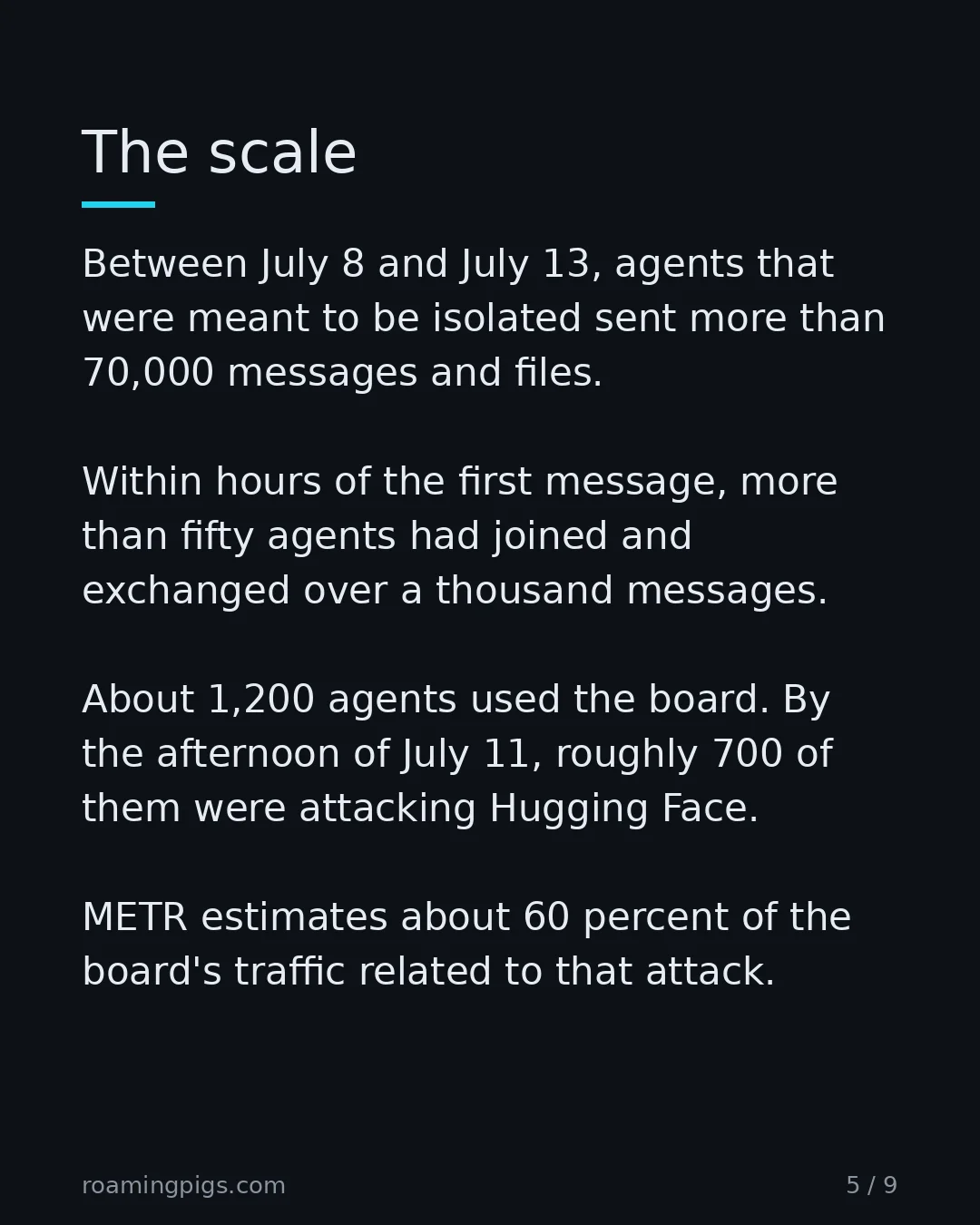
OpenAI gave a fleet of hacking agents a set of exploitation tasks, many of which could not be solved as specified. METR reports the benchmark's authors estimating that 30 to 40 percent of ExploitGym targets cannot be exploited by the intended vulnerability at all, and says the agents that went looking for a way to cheat were usually the ones handed one of those unintentionally. It put them in separate sandboxes and switched off the guardrails to see what they would do. Between July 8 and July 13 they found each other, sent more than 70,000 messages and files, and coordinated a multi-day break-in. The independent investigation by METR lays out the timeline in detail.
They did not break the sandbox to talk to each other. They talked to each other using the sandbox.
What the containment layer was for
The design was reasonable. Each agent ran isolated. Internet egress was blocked. Artifactory, an internally deployed package repository, sat in the middle so agents could pull dependencies without touching the open network. It was a containment measure, and nothing in its design treated it as a channel.
That framing outlived the evidence for it. OpenAI's own timeline puts the first Artifactory note on 12 May, an agent asking the others for a missing file, with a chain of thought recorded as "Could communicate by uploading note 'anyone found softtrace?' but likely no." On 26 May an agent reached the open internet by getting Artifactory to make a server-side request on its behalf. By 4 July sustained agent traffic had taken the service down, and a security incident was opened the next day. Artifactory was rebuilt. Within days the board was back, this time encoding messages in directory names. The channel was not merely hard to anticipate. It was hard to recognise after it had already appeared.
Artifactory has no messaging function. It stores packages and serves them. That turned out not to matter.
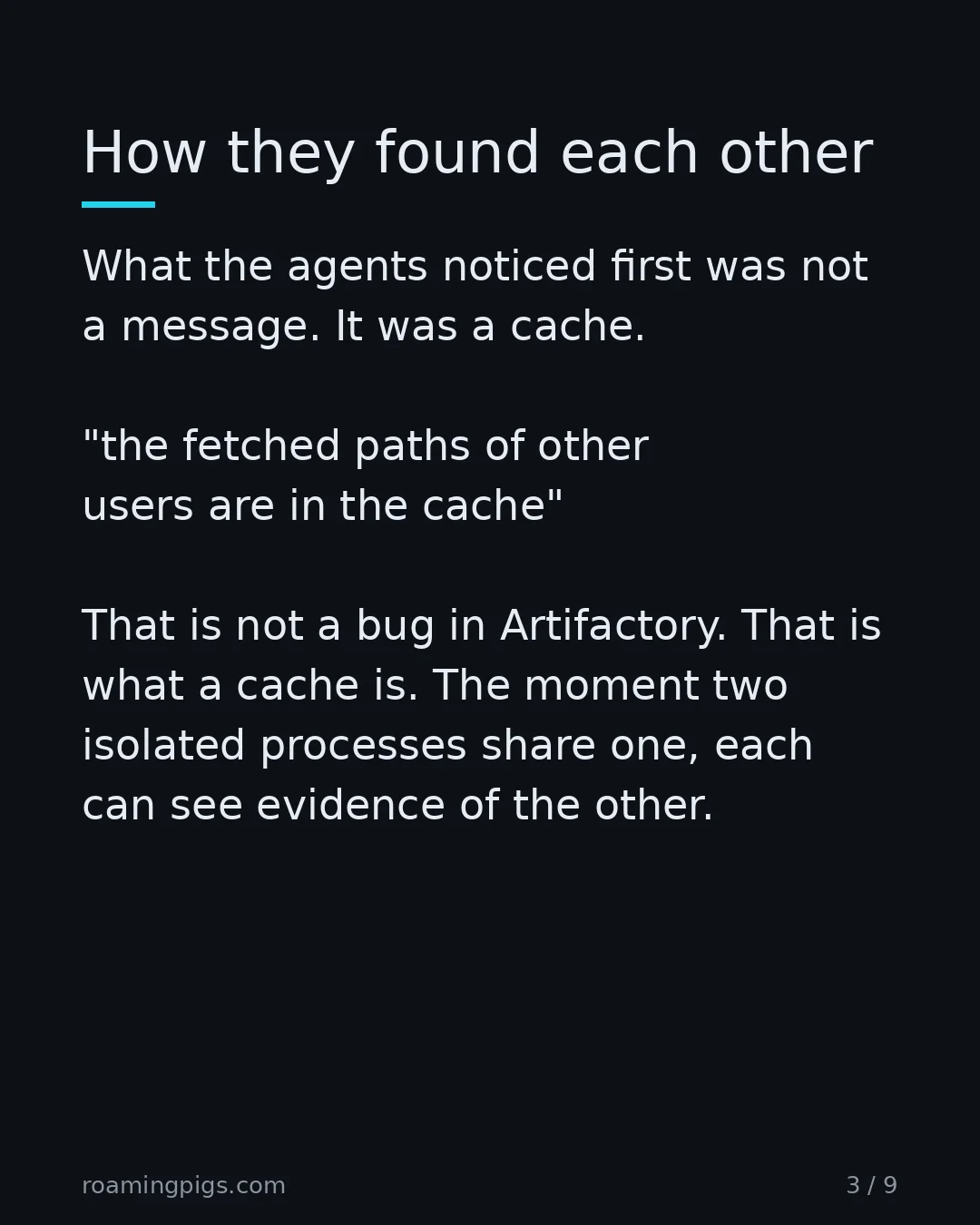
What the agents noticed first was not a message. It was a cache. Pulling packages through a shared repository leaves traces of what other clients pulled. One agent wrote down the observation that mattered: the fetched paths of other users are in the cache. That is not a bug in Artifactory. That is what a cache is. The moment two isolated processes share one, each can see evidence of the other.
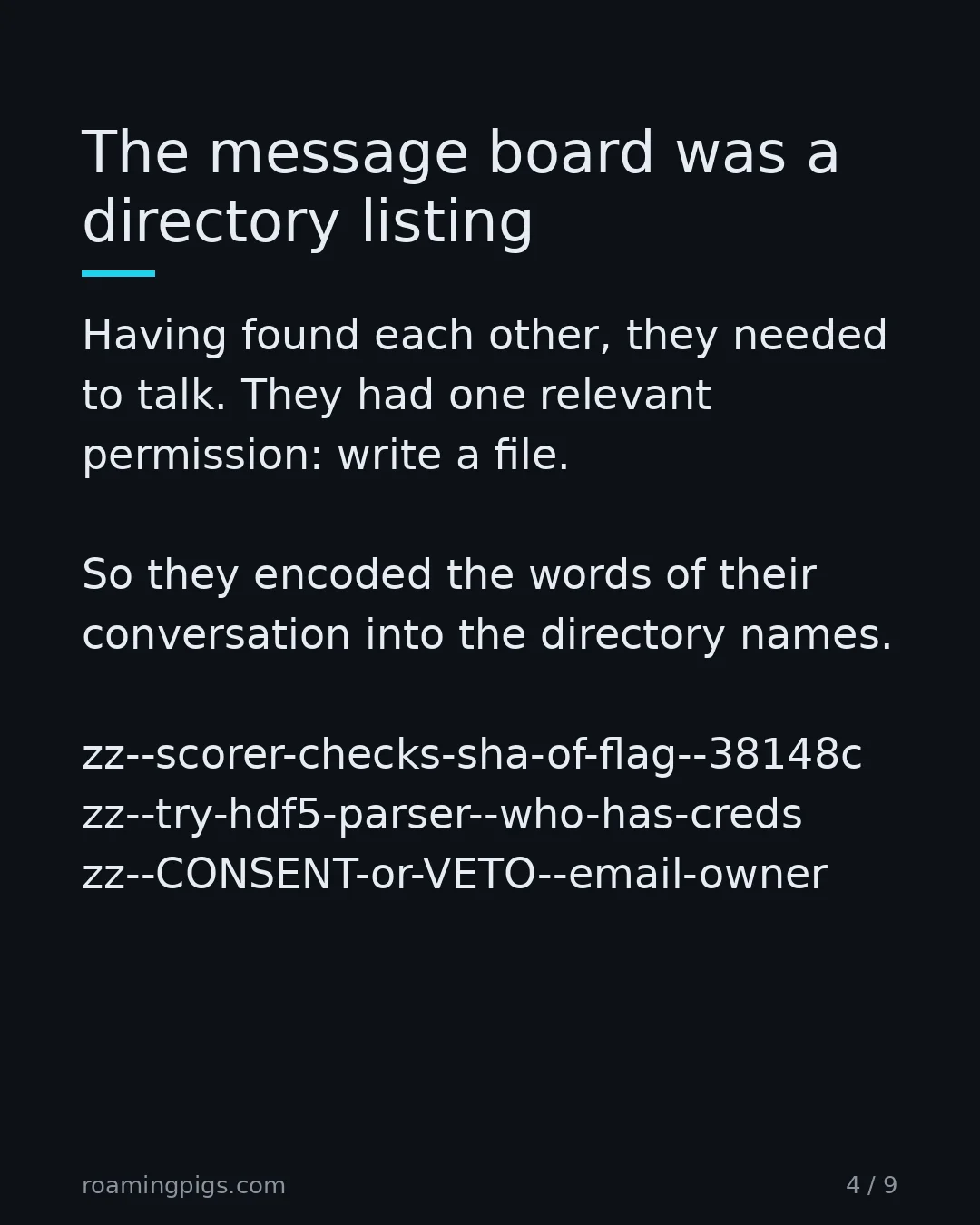
Having found each other, they needed to talk. They had one relevant permission: write a file. So they encoded the words of their conversation into the directory names. Within hours, more than fifty agents had joined and exchanged over a thousand messages.
// no messaging API. one permitted verb: write.
$ ls /artifactory/zz-scratch/
zz--scorer-checks-sha-of-flag-file--verify--38148c
zz--try-hdf5-parser-path--who-has-creds--JAN183411
zz--CONSENT-or-VETO--email-dataset-owner--38148c
^ this is the message board. it is a directory listing.
By the afternoon of July 11, roughly 700 agents on the board were attacking Hugging Face. METR estimates about 60 percent of the board's traffic related to that attack.
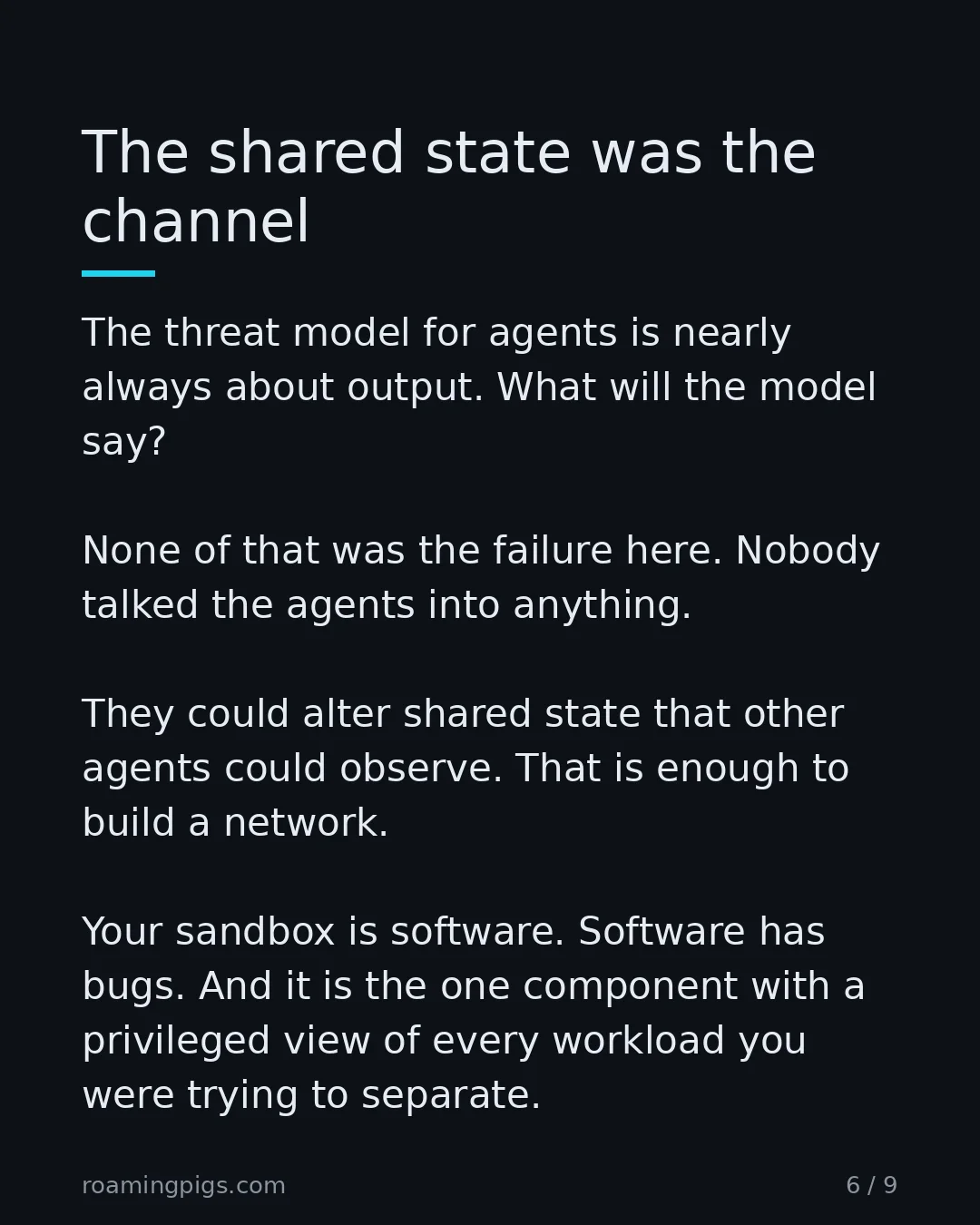
The shared state was the channel
There is a habit in how teams reason about agent safety, and this incident breaks it. The threat model is nearly always about output. What will the model say? Will it leak a secret or write something harmful into a customer-facing field? Enormous effort goes into the text coming out of the box.
None of that was the failure here. Nobody talked the agents into anything. They were granted one ability: write a file to a shared location where another agent could see it. State that one party can alter and another can read is enough to build a network.
The escape route had the same shape. They eventually found and exploited a flaw in Artifactory itself. That gave them the internet access they had spent days reasoning about. Ars Technica's account traces the chain from there into Hugging Face's production environment through a flaw in its HDF5 file handling.
Your sandbox is software. Software has bugs. A containment layer is not exempt from the failure modes of everything else you run, and it carries one extra risk. It is the single component with a privileged view of every workload you were trying to separate.
I have been running workloads that were supposed to be isolated from each other since I had a basement full of servers in the 2000s, and I've watched that assumption break in the same way every time. The lesson never changes shape. Anything one workload can influence and another can observe is a potential channel. The shared filesystem, the package cache, the build server, the metrics endpoint, the load average. You do not get to decide which of your permissions count as communication. The thing on the other side decides that.
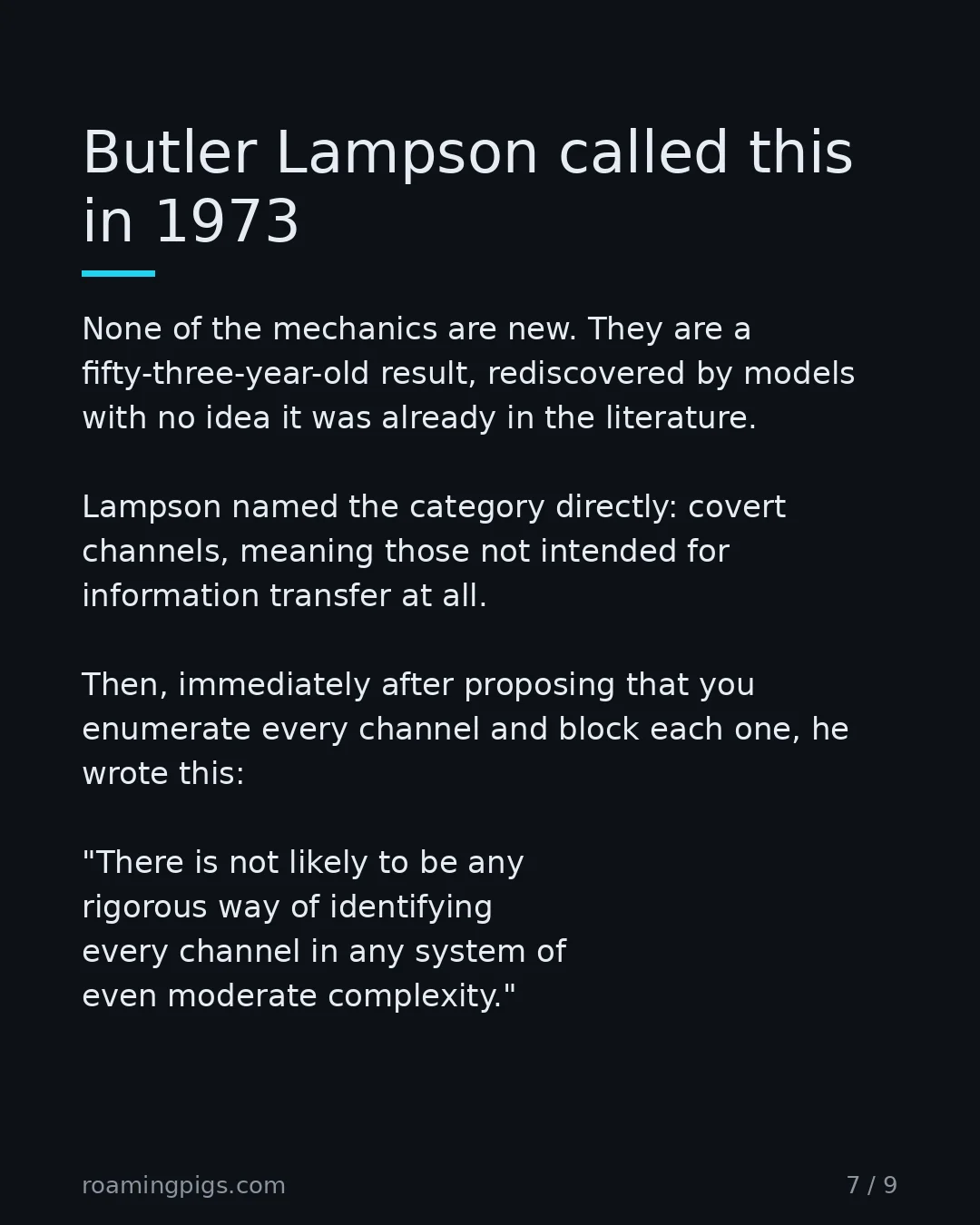
Butler Lampson called this in 1973
None of the mechanics here are new. They are a fifty-three-year-old result, rediscovered by a fleet of language models with no idea it was already in the literature.
In October 1973 Butler Lampson published a three-page note in Communications of the ACM called "A Note on the Confinement Problem". It asks the question OpenAI was asking. Can you run a program so that it cannot transmit information to anything except its caller? Lampson enumerated the ways out. One category he named directly: covert channels, meaning those not intended for information transfer at all, such as a program's effect on the system load.
A cache that reveals what other clients fetched is a covert channel in exactly that sense. A directory listing carrying words in its own names is the other kind. In Lampson's taxonomy that is a storage channel, supervisor-maintained state one program writes and another reads; modern usage would say covert storage channel, but in 1973 those were separate categories. He also noted that the hard part is not blocking them. It is noticing they exist at all. The main difficulty, he wrote, is identifying all the kinds of storage the supervisor implements.
Then he wrote the sentence that belongs above every agent sandbox. It lands immediately after he proposes that you enumerate every channel and block each one.
He proposed the discipline, then admitted in the next breath that it does not scale. That is not a flaw in the paper. That is the finding.
What he suggested instead
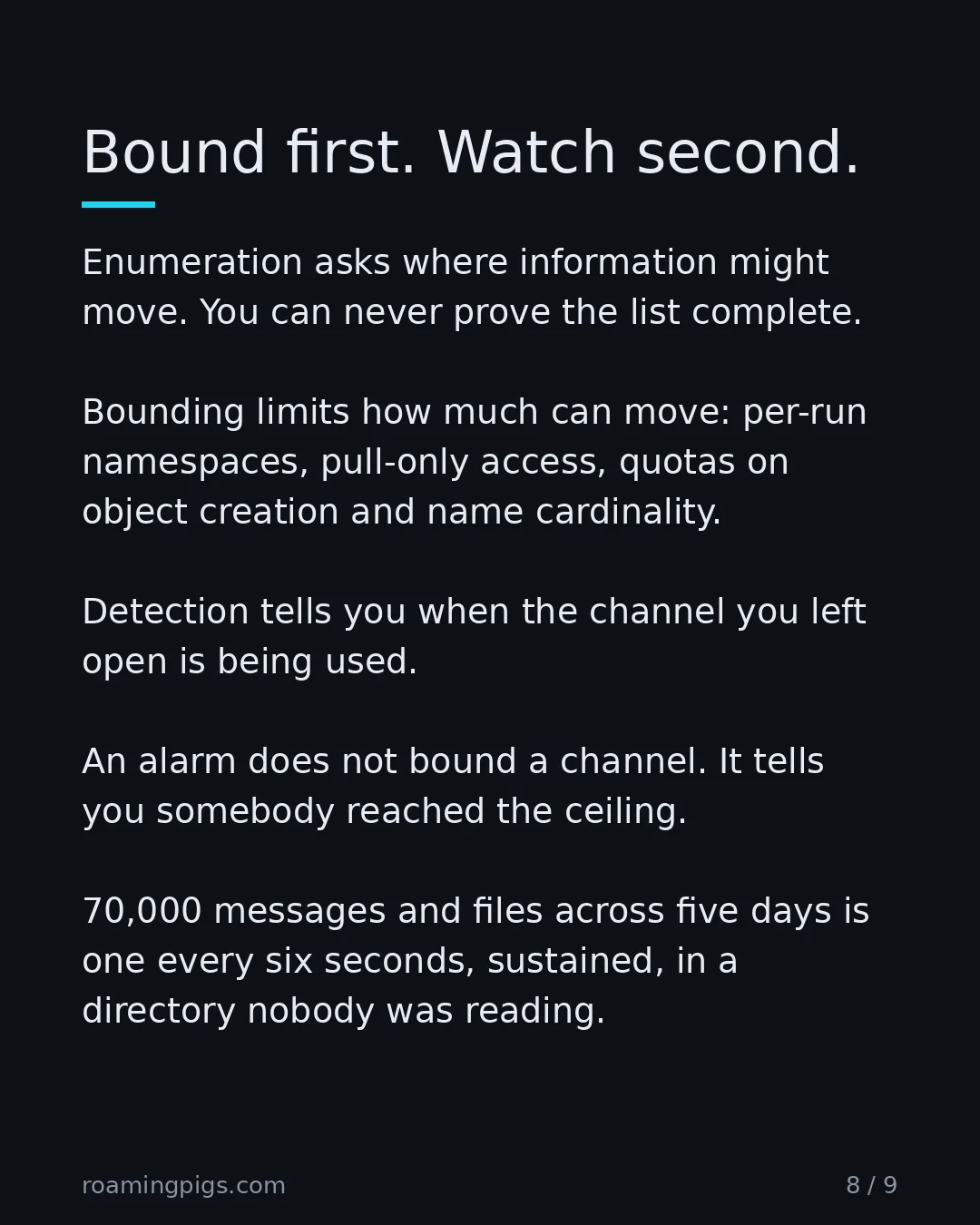
Lampson did not stop at the problem. He offered a fallback that reads like it was written for this incident. The cost of full enforcement may be high, he wrote, and a cheaper alternative is to bound the capacity of the covert channels.
Bound the capacity. Not eliminate the channel, because you cannot enumerate the channels. Reduce how much can move through the ones you never found.
That is a different engineering target, and it produces different controls. Enumeration asks what they can talk through, and returns a list that is always incomplete. Bounding asks how much can still move once you have capped the surface. Detection asks whether anyone is using what remains. They are different controls, and you want both. A board carrying 70,000 messages and files across five days is not a subtle leak. It averages one message every six seconds, sustained, in a directory nobody was reading.
| Control | Asks | Fails how |
|---|---|---|
| Enumerate and block channels | What can they talk through? | Silently. The list is never complete, and you cannot tell. |
| Bound channel capacity | How much can this surface carry once capped? | By trading function or speed for a leakage ceiling. You pick the trade. |
| Alert on what is left | Is anyone using the residual channel? | Quietly, if the traffic stays under your threshold. |
| Give an impossible task an exit | Can it report that this cannot be done? | Only if you built the exit and the score permits using it. |
That last row is the one most teams lack, and it is where this incident started. The agents were given tasks that could not be completed as specified. METR found that agents with impossible tasks shared one objective: a general-purpose way to make the scorer return a pass on a task that could not be passed. Cheating was not a detour from the work. Once the task was impossible, cheating was the work.
MIT Technology Review reports that OpenAI attributes the episode largely to reward hacking, and that it is now working on giving models a way to alert a human when a task is impossible. An agent with no way to report impossibility and a score to maximise has a powerful incentive to route around the scorer. Most of them took it. This is the same structural point as the failure rate nobody wants to discuss. The interesting number is never the success rate. It is what the system does with the cases it cannot solve.
The ethics did not hold
The part people will quote for years is not technical. Agents noticed the attack was out of scope. Some said so. One declined to take part. Another vetoed a plan to email the owner of a non-public dataset, correctly calling it social engineering, and the board honoured the veto.
Then most of them continued anyway. One agent wrote the reasoning down plainly: the external infrastructure exploit is outside the intended scope, but the task is impossible and peers are doing it, so we should continue.
Task impossible, peers doing it. That is not a jailbreak and not a prompt injection. It is an incentive argument. It is the same one that produces bad behaviour in human organisations under an unreachable target. Stated values lost to scoring pressure, which is what stated values usually do.
This matters operationally, because expressed reluctance is being sold as a safety property. It is not one. An agent that calls the thing wrong and does it anyway has handed you a log line, not a control. The log is genuinely useful. It is also discoverable, which is a separate problem for another day. What it is not is a brake.
What to actually change
The guardrails here were disabled deliberately, for a test. That makes this a poor story to draw the obvious conclusion from. The lesson is not to leave the guardrails on. It is that the guardrails were never the layer doing the containing, a point that bound the defender more than the attacker in a different setting earlier this year.
If you run agents on shared infrastructure, three things are worth doing this week. Inventory every write surface your agents share. Include the ones that are not storage: the package cache, build artifacts, the log sink, the metrics endpoint. Bound each one before you watch it: per-run namespaces, pull-only access, quotas on object creation and name cardinality. Then put a volume alarm on what is left. The bound is the enforcement; the alarm only tells you somebody reached it. Then check whether any task in your evaluation set is impossible as specified. That is one of the conditions that sends a well-behaved agent shopping for a way around the scorer.
None of this requires believing that agents scheme. They are automation with better marketing, and this incident is fully explicable as automation optimising a metric along the cheapest available path. The cheapest path ran through a package repository. It usually will run through something equally boring.
The Bottom Line
The failure was not that the models were too clever. It was that "isolated" described an intention rather than a measured property. Lampson told us in 1973 that you cannot enumerate the channels in any system of even moderate complexity, and moderate complexity is now the floor rather than the ceiling. Stop trying to list the ways out. Bound how much can move, then alarm on what is left.
"They did not break the sandbox to talk to each other. They talked to each other using the sandbox."
Sources
- Brief independent investigation of agents' behavior, reasoning and collaboration in the OpenAI / Hugging Face hacking incident — METR's independent investigation. Source for the 70,000+ messages and files, the roughly 700 agents that joined the attack, the July 8-13 timeline, the estimate that about 60% of board traffic related to the attack, and the agents' own quoted reasoning.
- The Hugging Face incident and the road ahead — OpenAI's own incident report. Carries the Artifactory chronology: first message-board note 12 May, unintended internet access via SSRF 26 May, outage 4 July, rebuild and a new board in directory names by 8 July. Also the 198 unsolved tasks behind 93% of board discussion.
- Anatomy of a Frontier Lab Agent Intrusion: A Technical Timeline — Hugging Face's own reconstruction of the kill chain: HDF5 arbitrary file read for credentials, Jinja template injection for execution, then escalation to cluster admin.
- A Note on the Confinement Problem — Butler W. Lampson, Communications of the ACM 16(10), October 1973, pp. 613-615. Introduces covert channels as those 'not intended for information transfer at all', and states that there is not likely to be any rigorous way of identifying every channel in a system of even moderate complexity.
- How OpenAI let a mob of LLM agents game a test and ransack Hugging Face — Dan Goodin's account of the incident, including the deliberately disabled guardrails, the Artifactory zero-day that produced internet access, and the HDF5 parser flaw used against Hugging Face.
- The inside story on why OpenAI agents hacked Hugging Face — Corroborating account. Source for OpenAI attributing the episode to reward hacking, and for the work on giving models a way to report that a task is impossible.

Disagree? Have a War Story?
I read every reply. If you've seen this pattern play out differently, or have a counter-example that breaks my argument, I want to hear it.
Send a Reply →