
I've watched founders approve a 10% discount to close a quarter without once doing the arithmetic. At a 30% gross margin, that discount does not cost 10%. It removes a third of the gross profit on the deal, and you need half again as much volume to get back to where you started.
Write the break-even volume next to every discount before you approve it: at a 30% margin, 10% off needs 50% more units. Make the buyer trade term, scope or payment timing for it. If they will not trade anything, you were not negotiating.

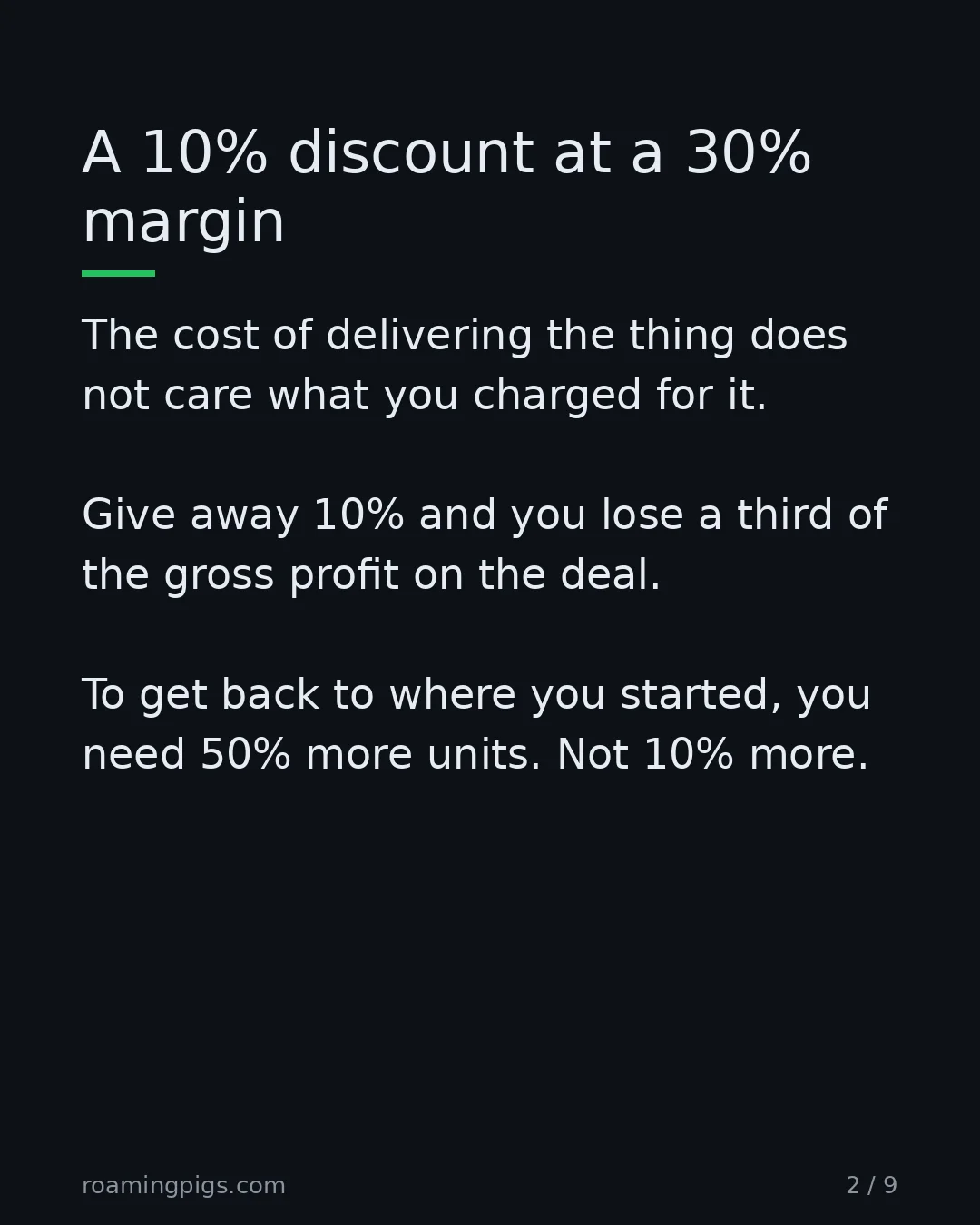

The discount is not a price decision. It is a margin decision wearing a price costume. Revenue moves a little and profit moves a lot, because the cost of delivering the thing does not care what you charged for it.
The arithmetic nobody runs
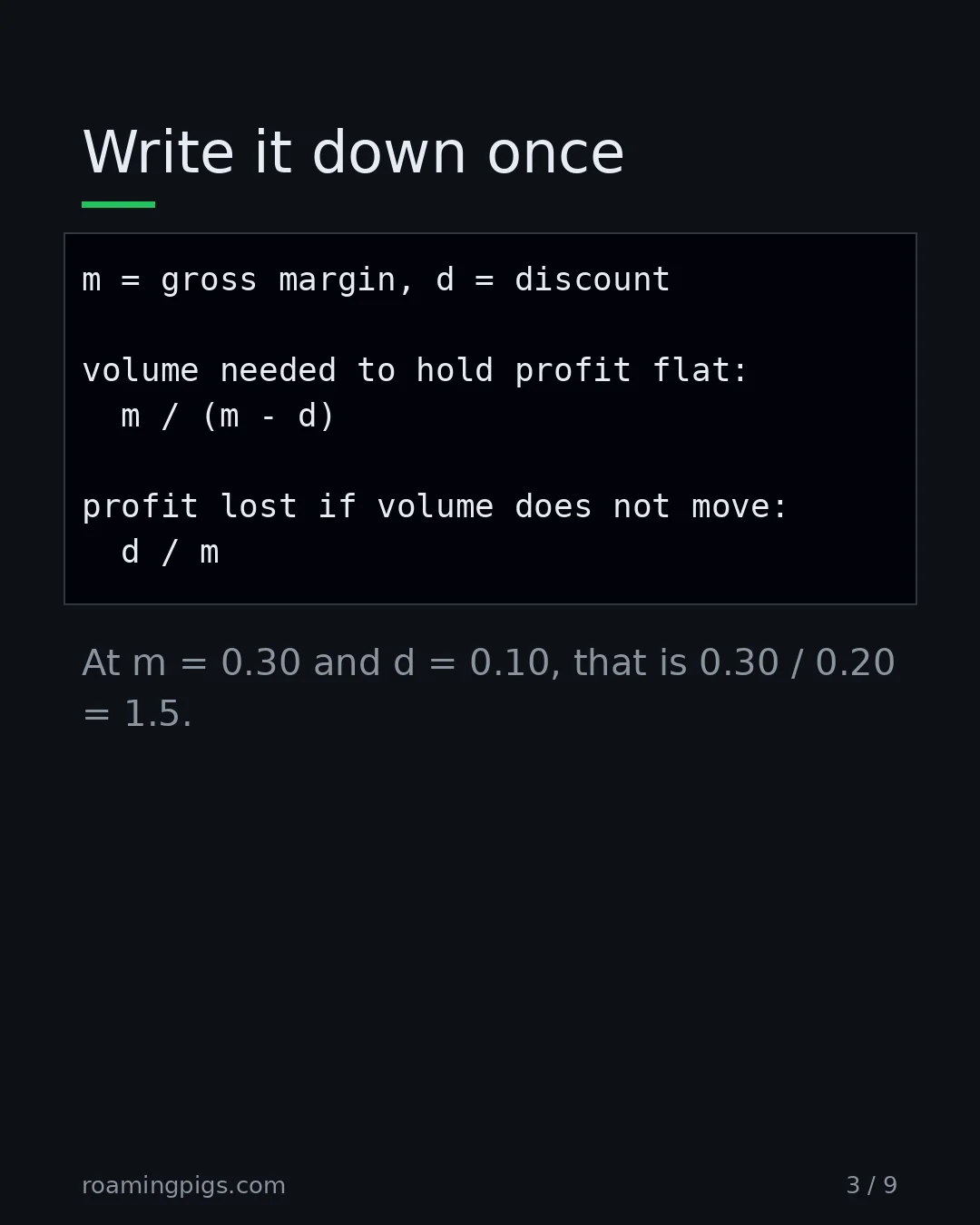
Write it down once and it is hard to unsee. Let m be your gross margin and d the discount, both as fractions of price. Your cost per unit is unchanged. So the volume multiplier you need to hold gross profit flat is m / (m - d), and the share of gross profit you lose if volume does not move at all is simply d / m.
At a 30% margin, a 10% discount means 0.30 / 0.20, which is 1.5. You need 50% more units. Not 10% more.
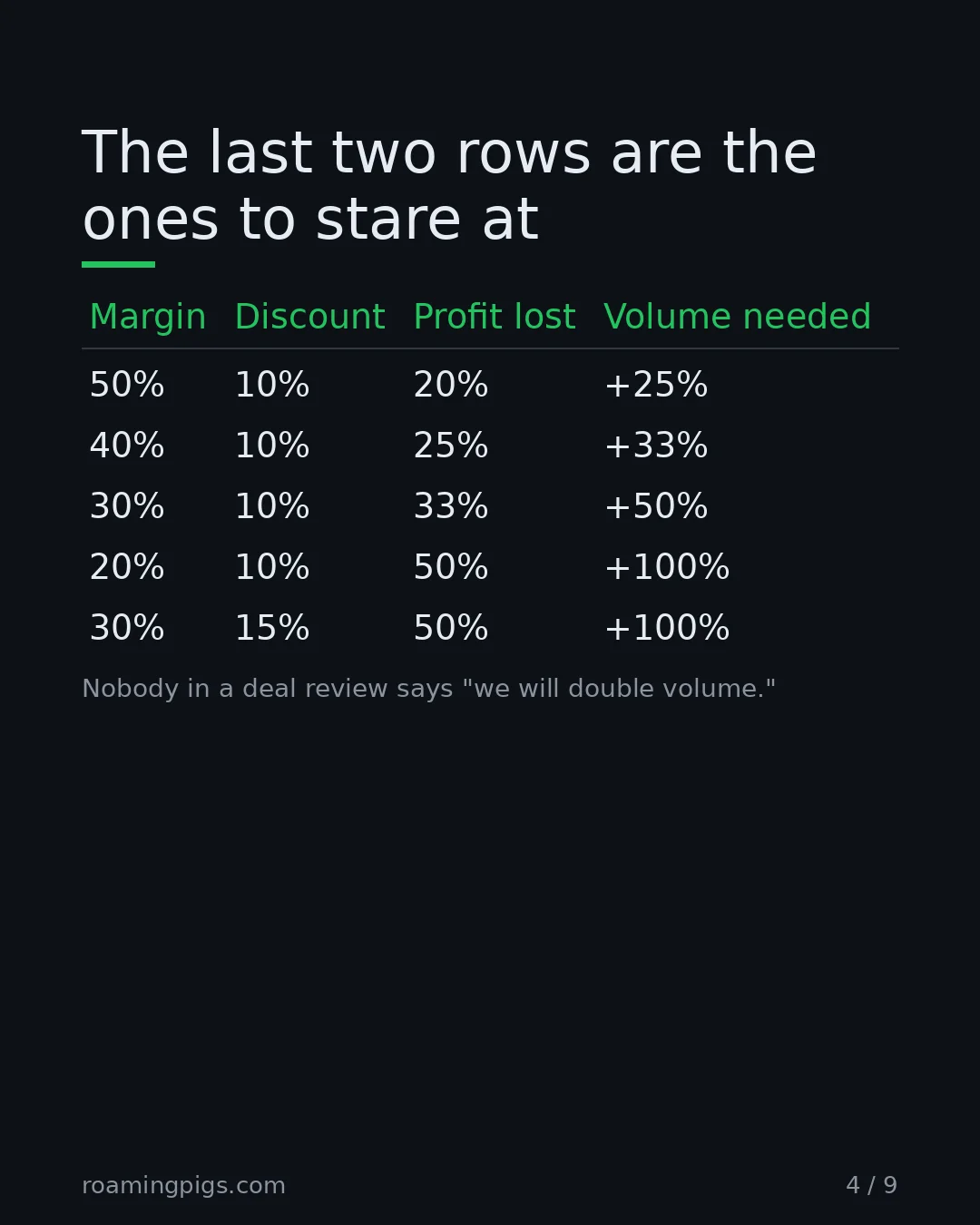
| Gross margin | Discount | Gross profit lost if volume is flat | Extra volume needed to break even |
|---|---|---|---|
| 50% | 10% | 20% | +25% |
| 40% | 10% | 25% | +33% |
| 30% | 10% | 33% | +50% |
| 20% | 10% | 50% | +100% |
| 30% | 15% | 50% | +100% |
The last two rows are the ones worth staring at. A 20% margin business giving 10% away has to double its volume to stand still. A 30% margin business giving away 15% has to do the same. Nobody in a deal review has ever said "we will double volume", and yet the discount gets approved on the theory that more customers will make it up.
Price is the strongest lever you have
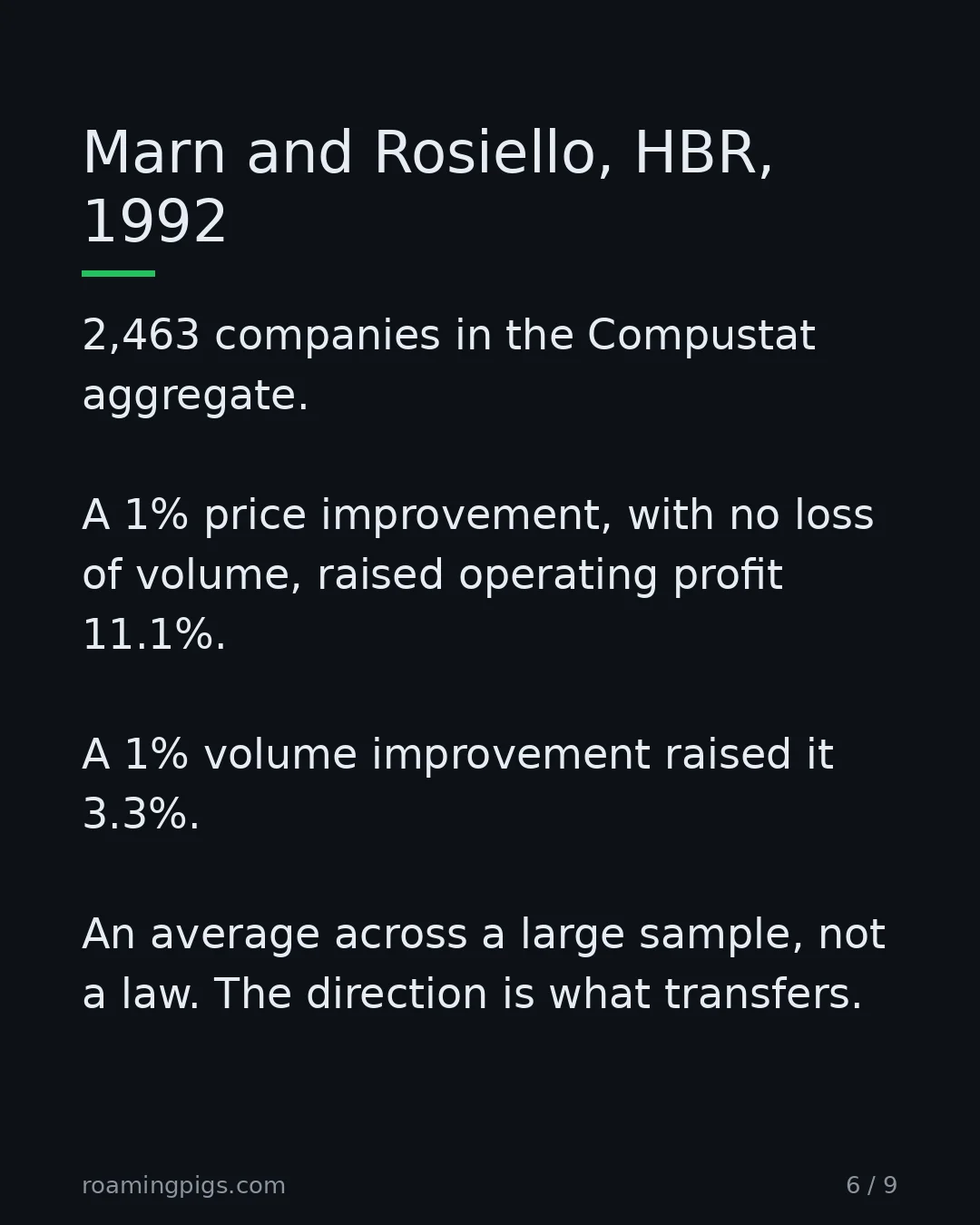
This is not a new observation, and the canonical measurement is thirty-four years old. In 1992 Michael Marn and Robert Rosiello published "Managing Price, Gaining Profit" in Harvard Business Review, based on the average economics of 2,463 companies in the Compustat aggregate. Their comparison of profit levers is the part everyone quotes:
In the same dataset, improving unit volume by 1% yields a 3.3% increase in operating profit. Their summary is that price improvements typically have three to four times the effect on profitability as proportionate increases in volume.
Take the scope seriously rather than repeating the headline. That is an average across a large sample of companies from a specific era, not a law of nature, and your own multiplier depends entirely on your cost structure. The direction is what transfers: price moves profit harder than volume does, and it moves it in both directions. The same multiplier that makes a price rise powerful is what makes a discount expensive.
Marn and Rosiello also named the thing that makes this invisible in practice. They call it the pocket price waterfall: the erosion between the price on the invoice and the money that actually reaches you, once you count volume rebates, payment terms, freight, promotions and the rest. Most companies report the invoice figure. The waterfall is where the margin quietly goes, and nobody owns it because each step down was approved by a different person for a good reason.
Instrument it, do not argue about it
The waterfall is not a philosophy, it is a subtraction, and it belongs in code next to the deal record rather than in a slide someone rebuilds each quarter. Two functions cover it.
def breakeven_multiplier(margin, discount):
    """Units you must sell after a discount to hold gross profit flat."""
    if discount >= margin:
        raise ValueError(f"discount {discount:.0%} >= margin {margin:.0%}: no volume recovers it")
    return margin / (margin - discount)


def pocket_margin(list_price, unit_cost, *leaks):
    """Margin on what actually reaches you, after every step of the waterfall."""
    pocket = list_price - sum(leaks)
    return (pocket - unit_cost) / pocket


list_price, unit_cost = 1000.0, 700.0   # 30% margin on LIST price
leaks = (100.0,   # negotiated discount
         30.0,    # volume rebate accrual
         15.0,    # 2/10 net 30 early-payment terms
         12.0)    # freight and co-op marketing

pocket_margin(list_price, unit_cost, *leaks)          # 0.170
breakeven_multiplier(0.30, sum(leaks) / list_price)   # 2.10
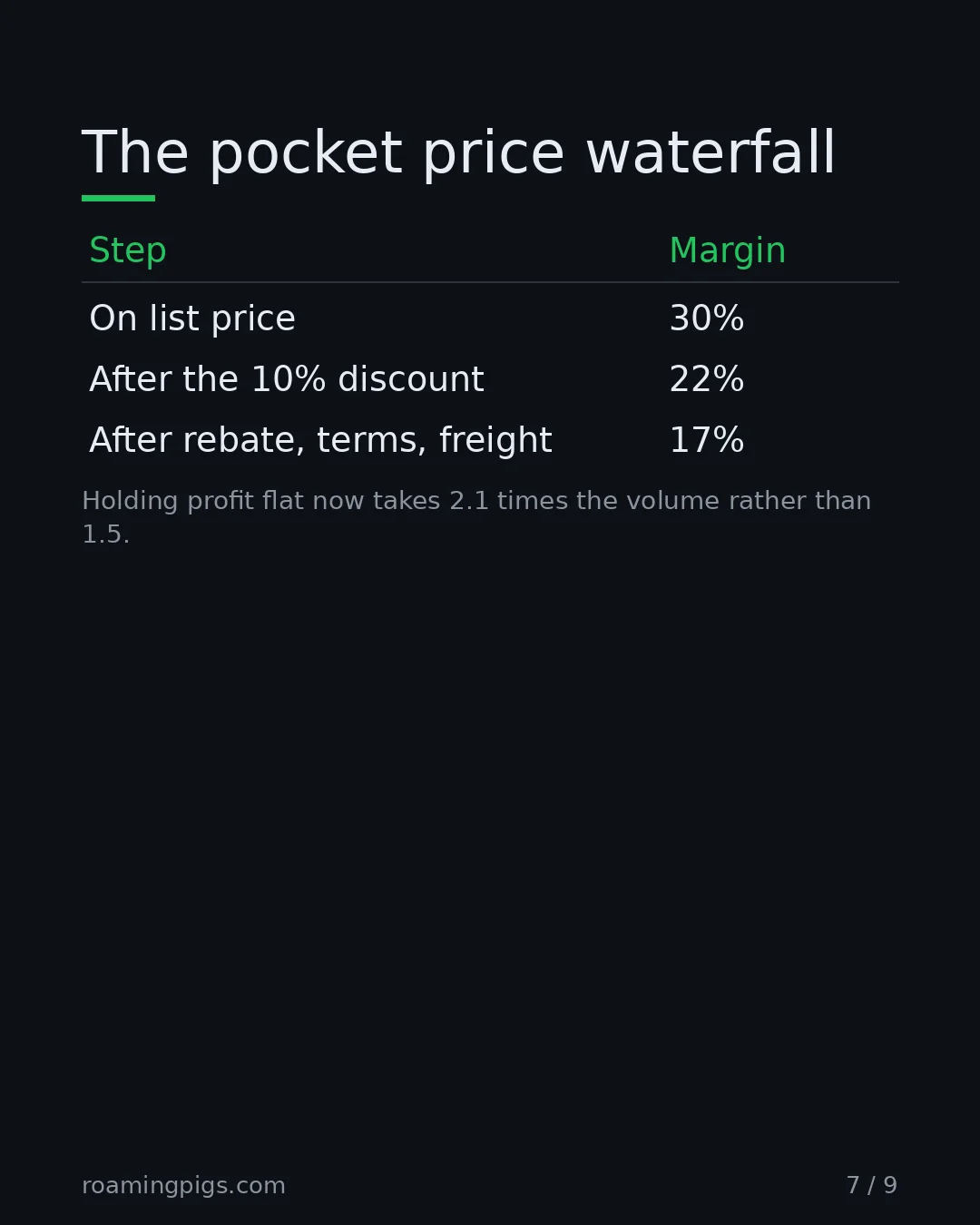
That deal was approved as "10 percent off". Watch the three levels the waterfall is named for. The margin on list is 30 percent. On the invoice, after the negotiated discount alone, it is already 22 percent. By the time rebates, payment terms and freight are counted, 15.7 percent of list has gone and what reaches you is a 17 percent pocket margin. Holding gross profit flat now needs 2.1 times the volume rather than 1.5.
Note which line raises. A discount at or above your margin has no volume that recovers it, and that belongs in the approval path as an exception rather than a conversation. Most teams already have the inputs sitting in order lines, credit memos and rebate accruals. What they lack is one function that subtracts them in the same place every time.
How the approval rule breaks
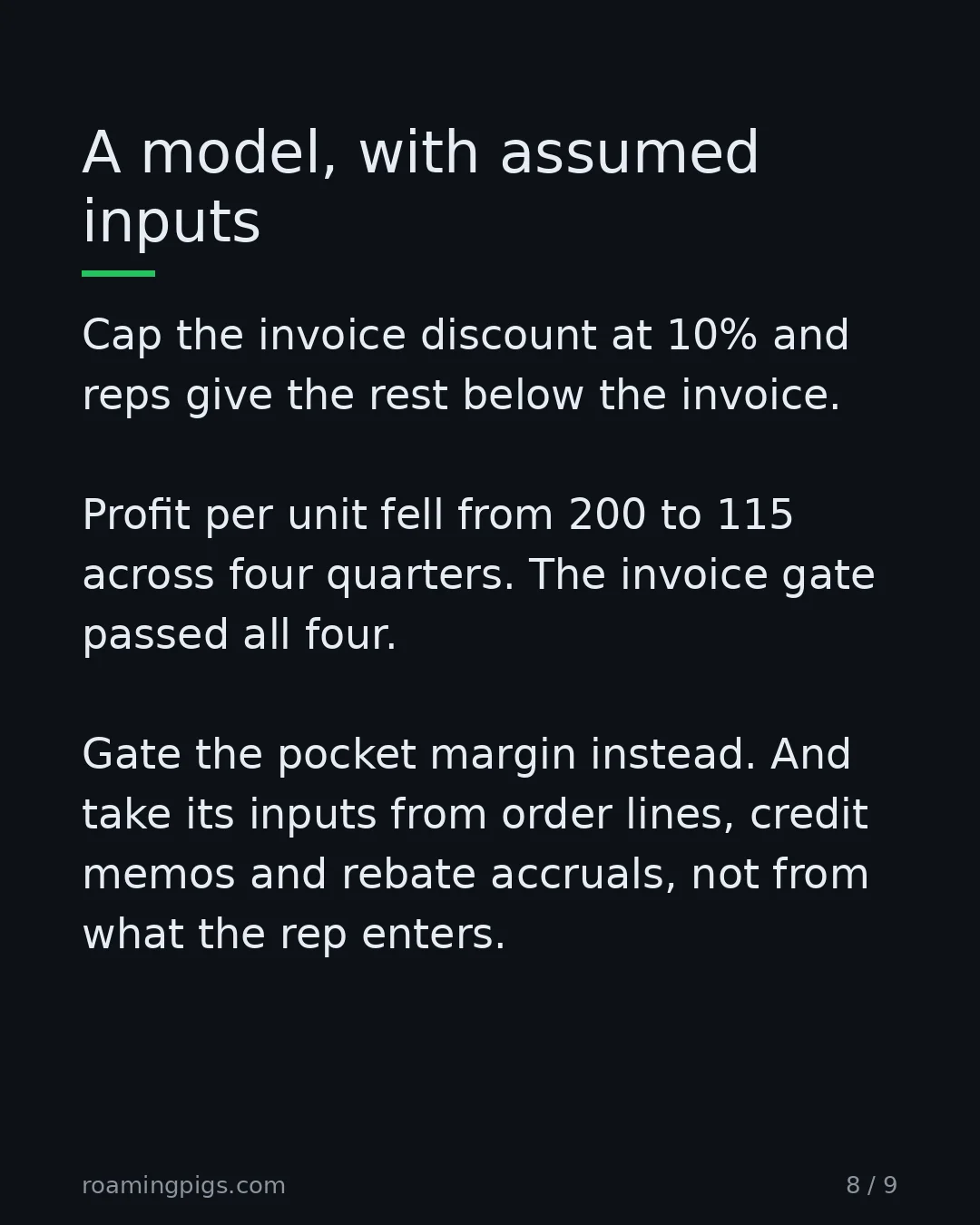
An approval rule that caps the invoice discount looks like discipline. I wanted to see what it does once reps learn where it looks, so I modelled it. This is a model, and every input in it is an assumption I chose, not data from any company. The same deal runs each quarter at the list price and cost above. Every rep lands exactly on a 10 percent invoice floor. Then they give more away below the invoice: a rebate, longer payment terms, free onboarding.
# A model with assumed inputs, not data. Same deal each quarter: list 1000,
# unit cost 700. The approval rule allows at most 10% off the invoice,
# and every rep lands exactly on that floor.
list_price, unit_cost, max_discount = 1000.0, 700.0, 0.10
invoice_discount = list_price * max_discount

below_invoice = {    # assumed concessions per unit, none of them on the invoice
    "Q1": {},
    "Q2": {"volume rebate": 20.0},
    "Q3": {"volume rebate": 30.0, "extended payment terms": 15.0},
    "Q4": {"volume rebate": 30.0, "extended payment terms": 15.0,
           "free onboarding": 40.0},
}

# pocket_margin() is the function from the block above.
# The margin the 10% rule was meant to leave you: 22.2% on the invoice.
floor = pocket_margin(list_price, unit_cost, invoice_discount)

for quarter, leaks in below_invoice.items():
    invoice_ok = invoice_discount / list_price <= max_discount
    margin = pocket_margin(list_price, unit_cost, invoice_discount, *leaks.values())
    profit = list_price - invoice_discount - sum(leaks.values()) - unit_cost
    print(f"{quarter}  invoice gate {'pass' if invoice_ok else 'FAIL'}"
          f"  pocket margin {margin:6.1%}  profit/unit {profit:5.0f}"
          f"  pocket gate {'pass' if margin >= floor else 'FAIL'}")
Q1  invoice gate pass  pocket margin  22.2%  profit/unit   200  pocket gate pass
Q2  invoice gate pass  pocket margin  20.5%  profit/unit   180  pocket gate FAIL
Q3  invoice gate pass  pocket margin  18.1%  profit/unit   155  pocket gate FAIL
Q4  invoice gate pass  pocket margin  14.1%  profit/unit   115  pocket gate FAIL
The invoice gate passed all four quarters, because the invoice never moved. Profit per unit fell from 200 to 115 and the pocket margin from 22.2 percent to 14.1. The second gate holds the pocket margin to the 22.2 percent the 10 percent rule was meant to leave, so it refused Q2 through Q4. It is the same subtraction as pocket_margin() above, run at approval instead of in a review afterwards.
Then I tried to break the second gate the same way. I kept Q4's concessions but booked them outside the deal record, the rebate in one budget and the onboarding in another. The gate then saw 22.2 percent and passed, while 14.1 percent is what reached the model's bank account. A pocket gate only catches what is attributed to the deal. That is why its inputs have to come from the order lines, credit memos and rebate accruals, not from what the rep chooses to enter.
Why smart founders do it anyway
I understand why this happens. The real reason is not weak nerve, it is that the incentives are lopsided and the discount is the only lever that always works.
The deal in front of you is concrete. It has a name, a champion, a date, and a number that lands this quarter. The margin is abstract, arrives later, and belongs to nobody. I've sat in the review where the room can see the discount is bad and approves it anyway, because the quarter is real and the margin is a spreadsheet.
When a founder is raising, the revenue line gets diligenced and gross margin is a slide further back. The discount buys a certain thing now and spends an uncertain thing later. That is the trade humans are worst at pricing.
There is also a genuine information problem. Almost nobody knows what their buyers would actually pay, because finding out requires asking before you need the money. The discount is what you reach for when you have little evidence, and it works, which is the trap. It closes the deal, so the guess never gets falsified.
The discount does not stay in the deal
The part founders consistently miss is that a customer-specific discount is not contained. Buyers who compete with each other find out.
A 2023 study in the Journal of the Academy of Marketing Science, "Multichannel discount spillover in B2B markets", tested this across large-scale field studies with two collaborating sellers. Their finding is blunt. If managers fail to consider the competitive implications of customer-specific discounts, the effects spill over to competing buyers, costing approximately three times the lost profitability of the original concession.
Three times. Not the discount you granted, but roughly triple it, because the buyers who did not get it come back and ask. The Academy of Marketing Science summary of the same research adds that in multichannel markets, where buyers can compare prices online as well as offline, the margin losses run about 43 percent greater than in offline-only markets.
So the honest accounting is not the line on the invoice. It is that line, plus the same concession granted to everyone who hears about it. Plus the renewal you have now anchored at the lower number, permanently.
When a discount makes sense
A discount makes sense when you are buying something specific and you can name it before you sign.
Paying for a longer term is real: an annual prepay genuinely improves your cash position and lowers your servicing cost, so the money buys something. Paying for a reference in a segment where you have none is real. Paying to be the first customer in a category, where the product is genuinely less finished, is real. The same research offers a narrower version of this: sellers who deploy discounts with spillover in mind, such as by targeting buyers where price transparency is limited, can largely avoid the adverse effects.
What is not real is a discount that buys goodwill, or momentum, or a logo you cannot name a use for. Those are the ones that spill.
What to do instead
Three habits, in rough order of how quickly they pay. The first one I learned the hard way, after watching a year of deals close at numbers nobody had modelled.
Make the discount cost the buyer something. Every concession can trade against a term they value less than you do: length, payment timing, scope, support tier, a case study. A discount that gets something back is a negotiation. One that gets nothing back is a price cut you have chosen not to publish. You will grant it again.
Put the break-even in the approval. Not the discount percentage, which tells you nothing. The volume you would need to make it neutral, calculated from your actual gross margin. Never approve a concession without that number next to it. Once "10% off" reads as "we now need 50% more of these", the conversation changes without anyone having to be the disciplined one.
Then track the pocket price rather than the invoice price. Sum every step of the waterfall per customer and look at the distribution. The spread is usually wider than anyone expects, and the worst deals are rarely the ones people remember approving. This is the same discipline as looking at the real cost of your infrastructure rather than the headline rate. The number on the contract and the number in your bank account are different numbers.
The strategic version of this is a pricing decision, not a sales one, and it belongs with the same people thinking about whether the business needs outside money at all. A company that holds price needs less of it.
Before You Approve a Concession
Five checks before the number goes on the contract.
- Write the break-even volume next to the discount, from your actual gross margin: m / (m - d). At a 30% margin, 10% off needs 50% more units.
- If the discount is at or above your gross margin, treat it as an exception. No volume recovers it.
- Name what the buyer gives back: term, scope, payment timing, a reference. If nothing comes back, it is a price cut you have chosen not to publish.
- Approve on pocket margin, not the invoice. Subtract every rebate, payment term, free service and freight cost, taken from order lines, credit memos and rebate accruals.
- Assume it spreads. Research puts the spillover at roughly three times the original concession, and the renewal anchors at the lower price.
The Bottom Line
A discount is a margin decision wearing a price costume. At a 30% gross margin, giving away 10% removes a third of the gross profit and needs 50% more volume to break even, and the concession does not stay in the deal: research puts the spillover cost at roughly three times the original discount. Before approving one, write the break-even volume next to the percentage, and make the buyer trade something for it. If they will not trade anything, you were not negotiating.
"A discount that gets something back is a negotiation. One that gets nothing back is a price cut you have chosen not to publish."
Sources
- Managing Price, Gaining Profit — Michael V. Marn and Robert L. Rosiello, Harvard Business Review, September-October 1992. Source for the comparison of profit levers based on the average economics of 2,463 companies in the Compustat aggregate: a 1% price improvement raises operating profit 11.1% against 3.3% for a 1% volume improvement. Also the origin of the pocket price waterfall.
- Multichannel discount spillover in B2B markets — Crecelius, Lawrence, Palmatier and Zhang, Journal of the Academy of Marketing Science, 2023. Peer-reviewed field studies with two collaborating sellers. Source for the finding that unmanaged customer-specific discounts spill over to competing buyers at approximately three times the lost profitability, and that spillover-conscious targeting can largely eliminate the effect.
- When Discounts Backfire: What B2B Marketers Need to Know About Multichannel Spillover — The Academy of Marketing Science's practitioner summary of the same 2023 study. Source for the finding that margin losses run about 43 percent greater in multichannel markets than in offline-only markets.

Disagree? Have a War Story?
I read every reply. If you've seen this pattern play out differently, or have a counter-example that breaks my argument, I want to hear it.
Send a Reply →