
I've watched search quality degrade over 30 years of using the internet. Nothing has accelerated that decline faster than the flood of machine-written content now polluting every search result.
Verify information sources manually—AI-generated content is flooding search results. Check publication dates, author credentials, and cross-reference claims.
Updated with additional context and related reading.
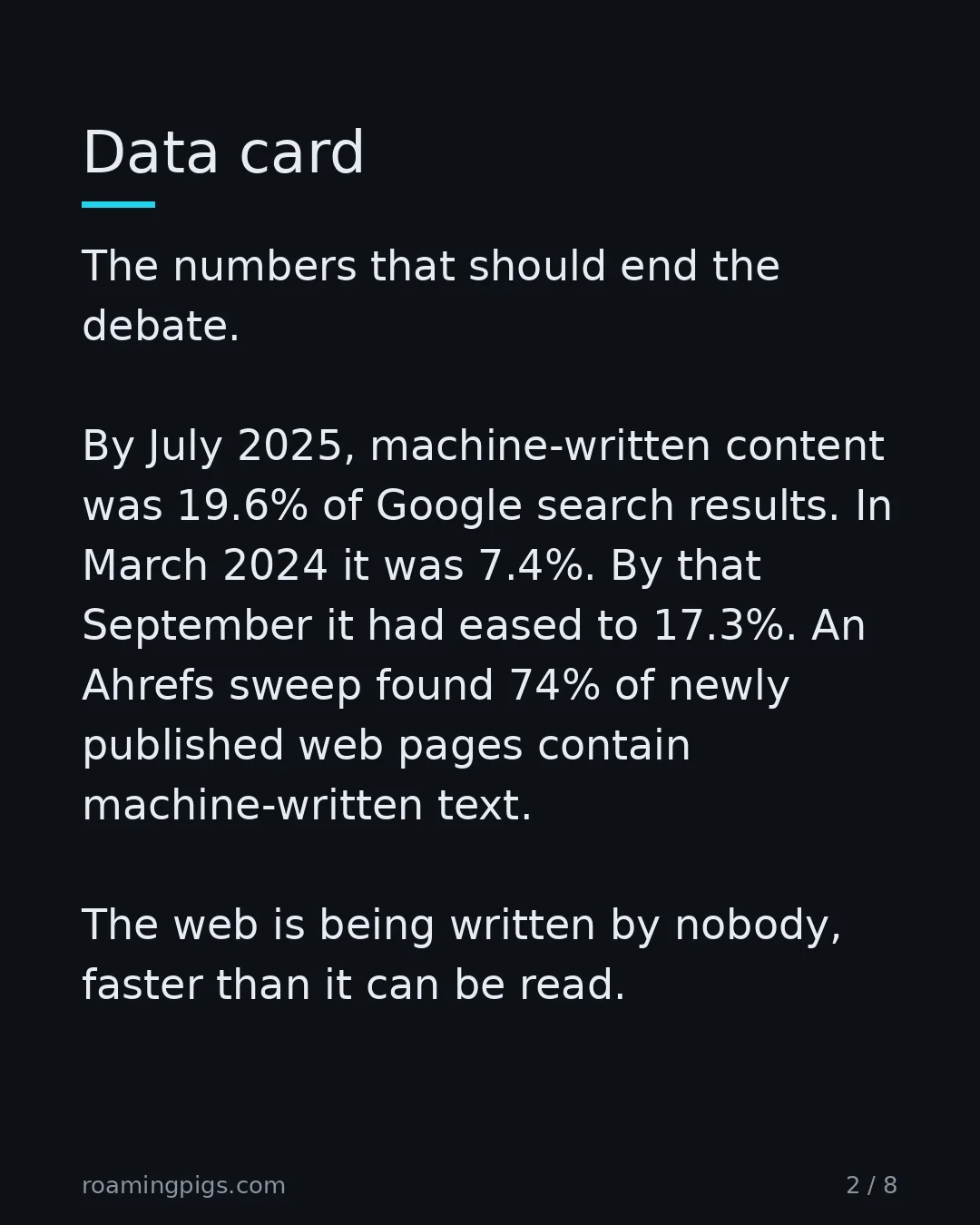

By July 2025, machine-written content accounted for nearly 19.6% of Google search results, up from 7.4% in March 2024 by Originality.AI's ongoing count of the top 20, and easing to 17.3% by that September, which is its own signal. An Ahrefs analysis of 900,000 pages found 74.2% of newly published web pages contain machine-written content. The web is drowning in machine-written slop, and it's making search nearly useless for finding genuine expertise.
This isn't progress. It's pollution at industrial scale.
The Scale of the Problem
Nobody knows the true share, and the number everyone quotes is worse than useless. iPullRank says it plainly: detection data can't be treated as fact, because language patterns aren't exclusive to humans or machines. What is measurable is the incentive. One operator scraped a competitor's sitemap, generated 1,800 articles, and took 3.6 million visits. That is the whole business model, and it needs no forecast to be alarming.
Content farms aren't new - they've existed since the early days of SEO. But AI changed the economics. What used to require hiring low-wage writers now requires only API credits. A single person can generate thousands of articles per day. The marginal cost of content creation has collapsed to nearly zero.
The Trust Protocol Collapse
Here's the physics that makes this problem unsolvable with current approaches:
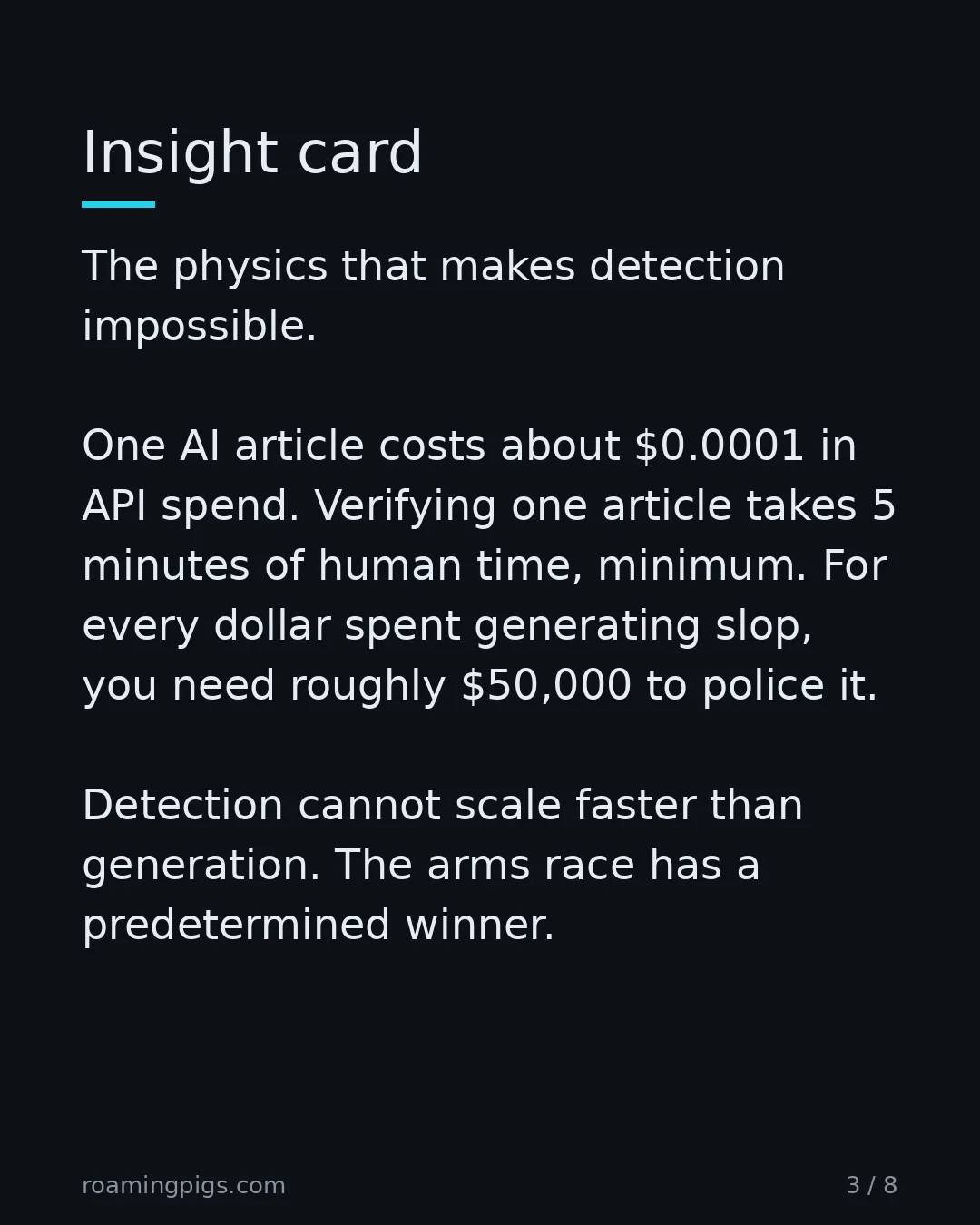
The cost of generating one machine-written article: approximately $0.0001 in API costs. The cost of verifying that article wasn't machine-written: 5 minutes of human time, minimum. This asymmetry is fatal.
For every dollar spent generating machine-written content, you'd need $50,000 in human verification costs to police it. The economics are inverted. Detection can never scale faster than generation. Every AI detection tool that emerges just gets incorporated into better AI generation. The arms race has a predetermined winner.
This is Information Thermodynamics in action: it's always cheaper to create disorder than to restore order. The verification cost inevitably exceeds the generation cost by orders of magnitude. No algorithm can escape this physics.
The result is predictable: quantity exploded while quality cratered. Search results now surface content optimized for algorithms rather than humans. The pattern recognition that makes LLMs impressive at text generation also makes them perfect for gaming search rankings at scale.
How AI Content Farms Operate
The business model is straightforward:
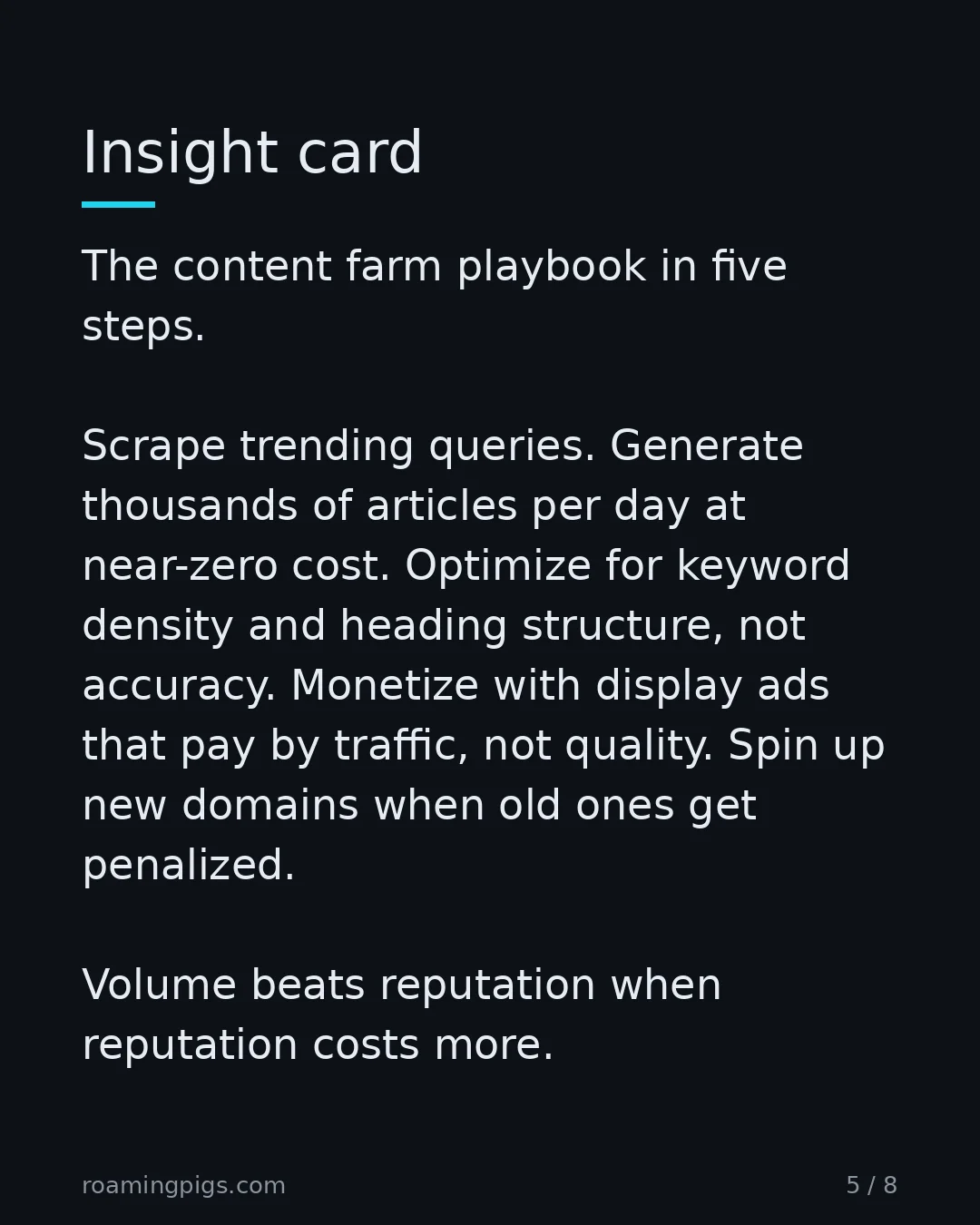
- Scrape trending topics. Use tools to identify high-traffic search queries with advertising potential.
- Generate articles at scale. Feed prompts to LLMs. Produce hundreds or thousands of articles per day covering every conceivable variation of every query.
- Optimize for ranking signals. Ensure keyword density, heading structure, and length match what Google rewards. The content doesn't need to be good - it needs to rank.
- Monetize with ads. Display advertising pays based on traffic, not quality. Bad content that ranks earns the same as good content that ranks.
- Repeat at scale. Spin up new domains when old ones get penalized. The economics favor volume over reputation.
This creates a race to the bottom. Sites publishing genuine expertise compete against sites that can generate 100x the content at 1% of the cost. The algorithm rewards volume and keyword matching, not accuracy or insight.
The Death of Expertise in Search
The people who actually know things, practitioners, researchers, experienced professionals, can't compete with content farms on volume. A doctor who writes one carefully researched article per month loses to a content farm that generates 1,000 medical articles per day.
This creates a visibility problem. Genuine expertise gets buried under machine-written content that superficially covers the same topics. The AI content isn't necessarily wrong (though it often is) - it's just empty. It lacks the judgment, nuance, and hard-won knowledge that makes expert content valuable.
I've searched for technical topics and found page after page of machine-written content that reads like it was written by someone who read the Wikipedia article and nothing else. The same pattern showing up in AI coding tools - content that looks plausible but lacks the depth that comes from actual experience.
Worse, machine-written content often confidently presents incorrect information. The model doesn't know what it doesn't know. It produces fluent text regardless of whether the underlying claims are accurate.
Google's Inadequate Response
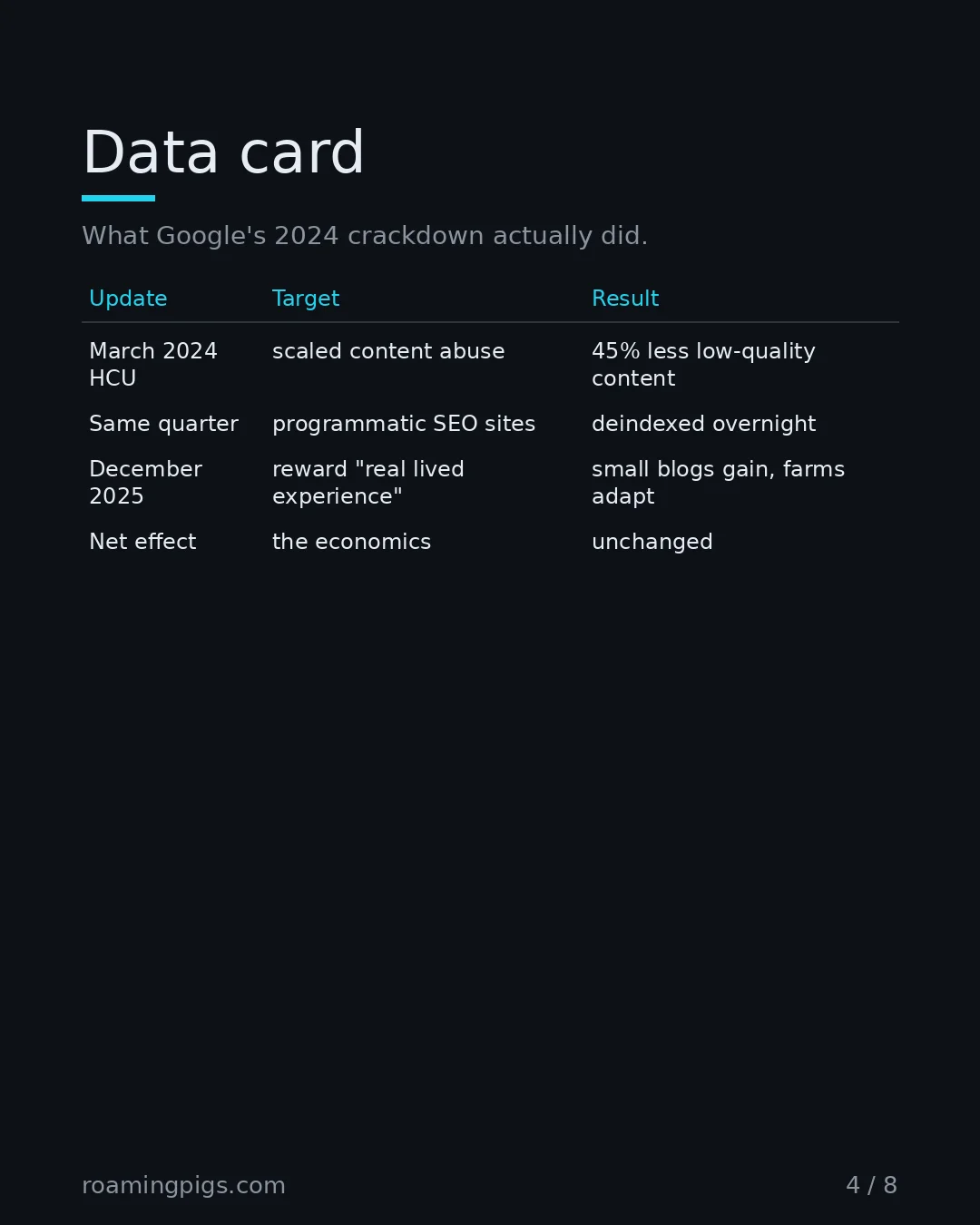
Google's March 2024 core update targeted "scaled content abuse" - mass-produced content designed to manipulate rankings. According to Google Search Central's documentation, the update resulted in 45% less low-quality content in search results. Some sites were completely deindexed overnight.
But the problem persists. Google faces a fundamental tension: they need content to index, and AI is producing most of the new content. Penalizing all AI content would leave their index sparse. So they target "abuse" rather than AI content itself.
This creates an arms race. Content farms adapt. They use AI to generate drafts, then add minor human edits. They vary output patterns to avoid detection. They build "authority" through link schemes. Google patches one exploit, farms find another.
The December 2025 update continued the crackdown, with Google explicitly rewarding smaller blogs written by people with "real lived experience." But the fundamental economics haven't changed. AI content is still cheaper to produce than human expertise.
Why This Matters Beyond Search
The machine-written content flood has consequences beyond annoying search results:
Knowledge degradation. If AI is trained on machine-written content, quality degrades recursively. Models trained on model output produce worse output. We're poisoning the well we draw from.
Trust erosion. When you can't trust that content was written by someone who knows the topic, you stop trusting written content at all. This pushes people toward video (harder to fake, for now) or personal networks (trusted sources). The public web becomes less valuable.
Expertise devaluation. Why spend years developing expertise if machine-written content outranks you? The incentive to become genuinely knowledgeable weakens when visibility goes to volume, not quality.
Misinformation amplification. AI confidently presents false information. Scale that across millions of pages, and misinformation becomes the default answer to common queries. This is the same confidence problem I've written about regarding the decline of technical blogging - AI makes it easy to produce content without the understanding that makes content valuable.
What Individuals Can Do
Until platforms solve this (if they ever do), individuals need strategies:
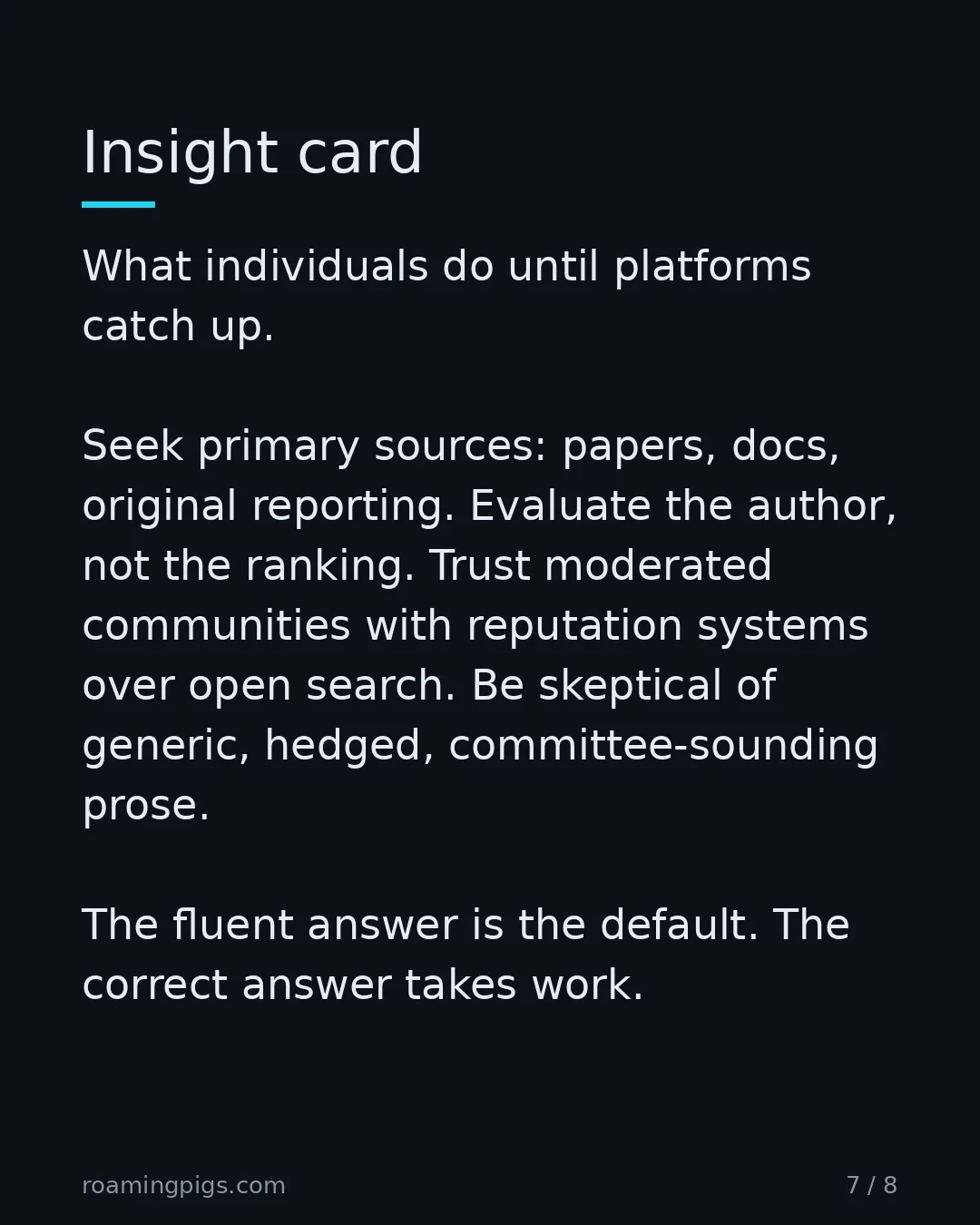
Seek primary sources. Academic papers, official documentation, original reporting. These are harder to fake and more likely to contain genuine expertise. Don't trust summaries - they're often machine-written.
Evaluate authors. Does the person have verifiable credentials in the topic? Have they built a reputation over time? Anonymous content from content-farm domains is worthless regardless of how well it ranks.
Use specialized communities. Reddit, Hacker News, Stack Overflow - moderated communities where reputation matters. These aren't immune to AI content, but the feedback mechanisms help surface quality.
Be skeptical of generic answers. AI content tends to be broad and non-committal. Genuine expertise often involves specific claims, strong opinions, and acknowledgment of tradeoffs. If content reads like a committee wrote it, AI probably did.
Block known content farms. Browser extensions like uBlock Origin can filter known machine-written content farms from search results. Technical guides on blocking AI content farms show how the "OnlyHuman" filter list specifically targets machine-written content sites.
Slop Detector
Spot machine-generated content in seconds. Click the red flags you notice:
The Longer-Term Trajectory
I've watched enough technology cycles to know prediction is difficult. But some patterns seem likely:
Human verification signals will gain value. Proof that content comes from a real human with real expertise will become a competitive advantage. We may see verification systems, reputation networks, or credentials that are hard to fake.
Walled gardens will grow. Platforms with strong moderation and identity verification will attract users fleeing the polluted public web. This has downsides - reduced accessibility, corporate control - but it's likely.
Search will fragment. Specialized search engines for specific domains (medical, legal, technical) with stricter quality standards may emerge. General-purpose search may become less useful for anything requiring expertise.
AI detection will improve and fail. Better detection will emerge, content farms will adapt, detection will improve again. The arms race continues until the economics change.
The Irony of Progress
The technology that was supposed to democratize knowledge is choking it. AI makes it trivially easy to produce content that looks like expertise without any underlying expertise. The result is that finding genuine expertise becomes harder, not easier.
We've automated the appearance of knowledge while making actual knowledge harder to find. That's not progress. That's a failure mode we should have anticipated.
The Authenticity Detection Kit
- Check author credentials before trusting any content from search results
- Use browser extensions to filter known AI content farm domains
- Seek primary sources (academic papers, official docs) over AI-generated summaries
- For critical decisions, verify claims across multiple human-written sources
The Bottom Line
Machine-written content farms are flooding search with machine-generated text optimized for ranking, not accuracy. The economics favor volume over quality, and genuine expertise gets buried under industrial-scale slop.
Until platforms solve this - and the incentives suggest they won't - individuals need to develop skepticism about any content found through search. Seek primary sources. Verify authors. Use communities with reputation systems. And recognize that the fluent text you're reading may have been written by no one who actually understands the topic.
The public web is being polluted faster than it can be cleaned. Adapt accordingly.
"We've automated the appearance of knowledge while making actual knowledge harder to find."
Sources
- Google: New updates to address spam and low-quality results — Google's own announcement of the March 2024 core update, updated April 26 with the measured result: 45% less low-quality, unoriginal content against the 40% it had expected
- iPullRank: The Content Collapse and AI Slop — Analysis of AI content's impact on search quality and the vicious cycle of machine-made content
- Bright Coding: Guide to Blocking AI Content Farms — Technical analysis and solutions for filtering AI-generated content from search results
- 74% of New Webpages Include AI Content (Study of 900k Pages) — 900,000 newly created pages, April 2025: 74.2% contained AI-generated content; 2.5% pure AI, 25.8% pure human.

Beat the Benchmark Gap?
If your production accuracy actually matches what the vendor promised, tell me your secret.
Send a Reply →